Secret parenthood
The Vampire Prince’s BrideSecret parenthood is the condition in which a child’s biological connection to a parent is deliberately withheld from that parent and from the surrounding social order. In the Alpha's Secret Son storyline, it is not merely a private family secret: Amanda’s decision to conceal Logan’s paternity affects Jace’s identity as an Alpha, Logan’s place within the pack, and the future of a relationship broken by ambition, separation, and fear.
Origin and Concealment
Amanda and Jace were high-school sweethearts until Jace was accepted into Harvard while Amanda stayed behind. One passionate night shortly before graduation left Amanda pregnant, but she did not tell him before the relationship ended. Jace left, and Amanda became a single mother carrying both the child and the knowledge of his parentage alone. The concealment therefore begins at a point of emotional rupture rather than indifference: the pregnancy arrives as the last consequence of a relationship that Jace believes has already ended.
For six years, Amanda resists contacting Jace even though she repeatedly sees him from a distance in town. The early years after Logan’s birth are especially difficult because she wants to tell Jace about his son, yet the thought of confessing produces palpitations. She dates another man within a month of graduation, but the relationship never develops beyond mild attraction, leaving Jace emotionally present even while he remains absent from Logan’s life. The secret becomes a daily discipline of silence, sustained through avoidance, rationalization, and fear of what disclosure would set in motion.
Amanda’s stated reason is not financial gain. She insists that Logan is fed and clothed, that she has a house, and that the rent is manageable; if she tells Jace, it will not be because she wants his money. Her deeper concern is institutional. Jace is returning as the Alpha after his father retires, and Amanda believes that the Alpha’s first child being born to someone who is not his mate could unsettle the entire pack. She tells Betty that keeping silent is best for everybody, even as Betty challenges the phrase by asking who, precisely, benefits from it.
The Child and the Hidden Lineage
Logan carries signs of the truth even when Jace does not yet recognize them. In human form, the boy resembles Amanda’s father, which reassures Amanda that Jace may not immediately see himself in him. His personality, however, is strikingly like Jace’s: Logan is bold and confident, repeatedly becoming the leader of whatever group surrounds him. When he shifts, his Wolf looks exactly like Jace’s own. The hidden parenthood is thus written into both behavior and supernatural inheritance, making the secret unstable even before it is spoken.
Logan himself knows only that Jace is the returning Alpha and imagines that the powerful man might give him money for new books for the packland library. His innocent excitement contrasts with Amanda’s dread. While Logan talks about the visit, Amanda struggles to give him the attention he deserves because her thoughts are filled with Jace’s smile, scent, and confidence. The child’s ordinary anticipation exposes the emotional cost of the secret: the person most directly affected by the concealed lineage is still too young to understand why adults are managing his history around him.
The secret also intersects with the pack’s reproductive and political expectations. Jace is not simply a former boyfriend who has unknowingly fathered a child. He is a billionaire lawyer, a major public figure within the community, and the Alpha of his werewolf pack. His succession makes Logan’s existence politically consequential. Amanda fears not only Jace’s personal anger but also the possibility that the child’s birth outside Jace’s recognized mate relationship will challenge accepted assumptions about inheritance, legitimacy, and leadership.
Disclosure and Forced Exposure
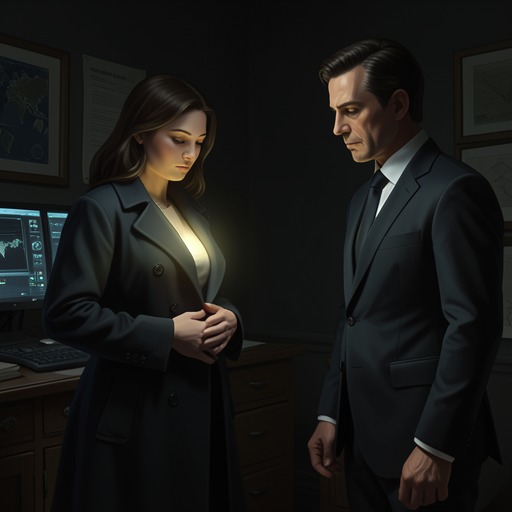
When Amanda finally faces Jace, she begins indirectly: she says that she should have told him. Jace’s controlled response reveals how dangerous the conversation feels to her; his even tone had signaled, during their school years, that he was close to losing control, and Amanda knows that anger could make him say hurtful things. She therefore tries to delay the argument and prevent Logan from witnessing a confrontation.
Amanda then states the concealed fact plainly: Logan is Jace’s son, and she became pregnant just before graduation. Jace interprets the silence as possible punishment for his decision to break up with her, turning the disclosure immediately into a dispute over motive as well as biology. Amanda acknowledges that he has a right to be angry but refuses to continue the conversation while Logan might see them fighting. The confession establishes paternity, yet it does not instantly repair the emotional history that made concealment seem safer than truth.
The private revelation is soon followed by public exposure. Betty wakes Amanda with a tablet displaying a photograph of Amanda and Jace from the previous day alongside Logan sitting on Jace’s shoulders, enclosed in a red circle beneath the caption “The Alpha’s Secret Son”. Amanda’s first reaction is to ask whom Betty told, showing that her fear has shifted from whether Jace will know to how widely the information will circulate. The headline converts a family secret into a spectacle and frames Logan’s identity through Jace’s political title, making the child’s parentage inseparable from the Alpha’s public image.
Secrecy as Identity Management
Across the wider supernatural world, concealed identity repeatedly functions as a survival strategy. Michelle Handsworth recognizes that Cain Samson is not an ordinary human because she can sense the smoke associated with his hidden nature, while everyone else sees only a successful, wealthy hockey player. Sara conceals her humanity behind a full-skin blue tattoo and golden bionic eyes because human beings are rare, expensive commodities who may be collected, dissected, or denied a peaceful welcome. Maximillian Barnes explains to Scarlett Brenan that he hides his ability to become a gorilla because disclosure could make people afraid, cause them to leave, expose his secret, or invite government action against him merely for existing.
These parallels clarify why secret parenthood carries more than ordinary embarrassment. Concealment protects relationships and social standing, but it also creates a fragile performance that requires constant control of appearances, timing, and speech. Bianca can recognize what Eric McKenna is without being able to say it aloud, while Sheridan and Maribel’s reunion is interrupted by an official warning that removing a human from custody could be treated as a hostile act. In each case, the hidden truth is shaped by unequal power: the person who knows must calculate the danger of telling, and the person who does not know may be denied the ability to act on reality.
Amanda’s secret follows the same pattern but places a child at its center. She suppresses the truth to protect Logan, to avoid appearing opportunistic, and to prevent a disturbance in the pack. Yet the resemblance between Logan and Jace, the boy’s inherited Wolf, and Jace’s return as Alpha make concealment progressively less sustainable. The secret does not disappear; it accumulates pressure until private confession and public scandal arrive almost together.
Consequences and Significance
The revelation changes three relationships at once. Jace must confront his biological connection to Logan, Amanda must answer for six years of silence, and Logan’s position within the pack can no longer be treated as ordinary. The disclosure also collides with Jace’s established life: he returns with a girlfriend while assuming he has left his hometown and its old attachments behind, only to discover that he has a son he never knew existed.
Secret parenthood therefore operates as both a state of concealment and a narrative engine. It creates suspense through withheld knowledge, but its deeper force comes from the conflict between protection and autonomy. Amanda believes she can decide what truth will do to everyone involved; the eventual confession and tabloid exposure prove that no individual can permanently contain a fact embedded in bloodline, supernatural inheritance, and public succession. Logan is first presented as the Alpha’s unknown child, but the disclosure forces the community to recognize him as a person whose identity has been shaped by an absence he did not choose.